Kill and Dump: The Silent Genocide in Balochistan
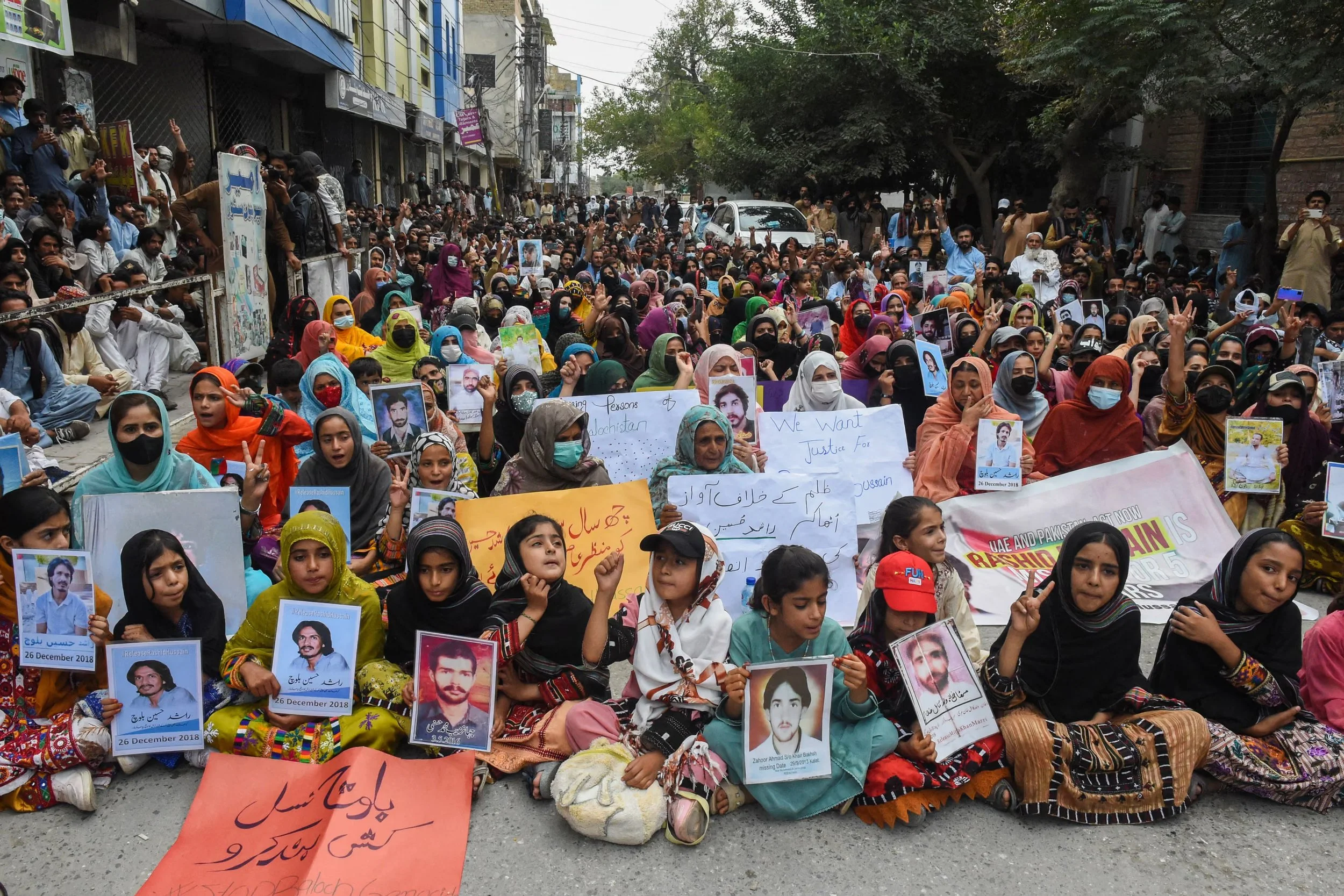
Relatives of missing people at a BYC gathering in Quetta. Photograph from Banaras Khan/AFP/Getty Images, as cited in the Guardian
“Indifference is the most insidious danger of all”
A child cannot build a future while learning to recognize the sound of gunfire. That truth is easy to acknowledge in conflicts that dominate international headlines. It becomes far more uncomfortable when the violence is deliberately hidden from the world.
For decades, Pakistan’s southwestern province of Balochistan has existed in the shadows of global attention. Families have searched for loved ones who vanished without explanation. Students have disappeared on their way to class. Mothers have buried children killed while demanding answers. Entire communities have been told that their grief is inconvenient, their voices dangerous, and their demands for justice a threat to the state.
And while this continues, much of the world remains silent.
Silence is never neutral. It protects those with power while abandoning those who have none. Every disappearance, every act of violence, and every attempt to suppress the truth steals another piece of childhood. A generation is being raised in an environment where fear has become routine and justice remains painfully out of reach.
Balochistan is not poor because it lacks resources. It is one of Pakistan’s richest provinces, home to vast reserves of natural gas, copper, gold, and a strategically significant coastline. Yet despite this wealth, it remains one of the country’s most underdeveloped regions. Many communities continue to face limited access to education, healthcare, clean water, employment opportunities, and basic public services.
For generations, Baloch communities have argued that they have been politically marginalized while their land has been exploited for its resources. Some advocate for independence. Many simply demand political representation, equitable development, accountability, and the right to live without fear.
Instead, human rights organizations have documented decades of enforced disappearances, arbitrary detention, torture, and extrajudicial killing carried out during Pakistan’s counterinsurgency operations. Families describe a horrifying pattern known locally as “kill and dump”, in which loved ones disappear only to be found later bearing signs of torture, or never returned at all.
But even in the face of unimaginable loss, Baloch families have refused to remain silent. Among the most prominent voices is Dr. Mahrang Baloch, a physician and human rights defender whose own family has experienced the pain of enforced disappearance and state violence. Through the Baloch Yakjehti Committee (BYC), she has helped organize peaceful demonstrations demanding accountability and the safe return of missing persons.
In March 2025, protests intensified after several individuals, including Bebarg Zehri and Dr. Illyas Baloch, were reportedly detained. Demonstrators gathered in Quetta to demand their release. Human rights organizations reported that security forces opened fire on the crowd, killing multiple protesters, including a 12 year old child, and injuring many others. Reports also found that ambulances were prevented from reaching the wounded.
The following day, protesters staged a sit-in alongside the bodies of those who had been killed. During the government’s response, Dr. Mahrang Baloch and other activists were arrested, while internet services across Quetta were reportedly shut down, creating a communication blackout that made independent reporting even more difficult.
Despite arrests, violence, and censorship, demonstrations continued across Balochistan and spread to cities including Karachi and Islamabad. Families refused to abandon their search for justice, even as the risks continued to grow. Many Baloch students themselves become targets. Human rights organizations have documented growing concerns over the disappearances of university students and young activists, raising fears that education is no longer viewed as protection but as another reason to be targeted.
Every enforced disappearance creates more victims than the person who is taken. It leaves children waiting for fathers who never come home. It forced older siblings to become caregivers overnight. It interrupts education, deepens poverty, and replaces childhood with uncertainty.
Conflict does not only destroy buildings. It reshapes childhood itself. A child who grows up fearing that a parent may disappear at any moment is carrying a burden no child should ever have to bear. These wounds last, while headlines continue to fade.
The greatest ally of injustice is not always violence. Often, it is indifference. Governments rely on the world’s attention span being short. They rely on stories like these remaining buried beneath the next new cycle. They rely on people believing there is nothing they can do.
UnitedForOthers rejects this belief, and urges you to as well.
Change begins with refusing to look away. It grows when we amplify the voices of families demanding justice, support organizations protecting children affected by conflict, and pressure government and international institutions to investigate credible allegations of human rights abuses.
Every movement for justice began because ordinary people chose action over comfort. The children of Balochistan cannot afford another generation of silence.
Works Cited:
Baluch, D. (2025, March 23). Pakistan’s War on Balochistan: A Point of No Return. Genocidewatch. https://www.genocidewatch.com/single-post/pakistan-s-war-on-balochistan-a-point-of-no-return
Middleton, E. (n.d.). Pakistan «World Without Genocide - Making It Our Legacy. World without Genocide. https://worldwithoutgenocide.org/genocides-and-conflicts/pakistan
Naeem, A. (2026, February 3). Pakistan’s Baloch students are vanishing, and no one is held accountable. The New Humanitarian. https://www.thenewhumanitarian.org/news-feature/2026/02/03/pakistans-baloch-students-are-vanishing-and-no-one-held-accountable
Paria Anjum Rajput. (2024, February 28). Balochistan and the Shadows of Genocide - Human Rights. Human Rights. https://humanrights.albion.edu/2024/02/28/balochistan-and-the-shadows-of-genocide/
Say The Truth. (2026). Silent Genocide: The Hidden Massacre of Balochistan. History. https://vocal.media/history/silent-genocide-the-hidden-massacre-of-balochistan
Statement on Pakistan’s Genocidal Enforced Disappearances in Balochistan. (2023). Lemkin Institute . https://www.lemkininstitute.com/statements-new-page/statement-on-pakistan%E2%80%99s-genocidal-enforced-disappearances-in-balochistan